Does hard water cause drain problems, or only water heater problems?
The bathroom sink used to run fine. Now it drains a little slower each month. That slow creep is the sign of scale, not a clog.
Hard water does more than coat a water heater. Minerals from the supply side leave a chalky layer inside a trap. In a bathroom line they bind with soap residue into a hard, grey film. The bore narrows a fraction at a time, so you notice a gradual slowdown rather than a sudden blockage.
Old cast iron is a different problem. Inside drain pipe that has been in the ground or a wall for decades, rust forms lumpy mounds called tubercles. These are not hard-water minerals. They are the pipe corroding from within, and they snag grease and paper.
The two tools do different work. A cable punches a hole through the build-up. Water drains again, but the scale stays on the wall and the line narrows again. Hydro jetting strips the wall back to the pipe surface.
Jetting old iron hard without looking first is a gamble, because thin, flaking pipe can fail under pressure. That is why a camera inspection comes first on old iron. It shows wall condition and cracks before anyone sets the pressure.
Safe homeowner check: find out whether one fixture is slow or every drain in the house is, then clean the visible stopper and trap.
Stop running water and call now if several drains slow together, or water backs up at a floor drain. One slow bathroom sink is usually a cable or trap job. A whole-house slowdown in old iron often needs a camera first and possibly jetting.
Expert Plumbers Co is a referral service. We connect you with an independent local plumber in Baisden, WV. Call (380) 262-9173.
A water softener changes the picture a little, and it is worth telling the plumber if you have one. Softened water leaves less mineral scale, but it can feel slippery and does not stop soap and hair from building up on the pipe wall. If your water is hard and you have no softener, the mineral film inside traps and short branch lines is the main cause of the slow creep. A simple habit helps: use a hair catcher in the tub and basin, and rinse the sink with hot tap water after use so soap does not cool and settle on the wall. Do not rely on vinegar or store-bought descalers to clear a drain, as they only treat the surface. In newer homes with plastic pipe, scale is mostly a trap and fixture issue. In older homes with iron or galvanized pipe, scale and corrosion together can narrow a line enough that replacing a section is more sensible than repeated cleaning.
What actually happens when a plumber comes to clear my drain, from the moment he arrives to the last flush?
Most people only see the machine come out of the truck. There is more to the visit than that, and knowing the order helps you tell a careful job from a rushed one.
An independent plumber usually starts with questions. Which fixtures are slow, which are fine, when it started, and whether you have noticed gurgling or a smell. One slow sink points to a branch line. Every drain in the house acting up points to the main line.
Next comes a look at access. That might be a sink trap, a tub drain, a toilet that has to be pulled, or a cleanout outside or in the basement. Floors and cabinets get covered with towels or a drop cloth.
Then the plumber picks the tool. A hand auger or small drum machine suits a sink or shower. A larger cable machine suits a main line. If grease or heavy scale is suspected, hydro jetting may come up instead, and a camera may be suggested before anything else.
The cable goes in and is fed forward by feel. A clog gives resistance, then a change when the cutting head breaks through. Roots, grease and soft paper each feel different, and a careful plumber will tell you what the cable seemed to hit. When the cable comes back out, whatever clings to it is worth a look. Hair, wipe fibers, root hairs or a greasy paste all point to a cause.
After that comes the test flush. Water runs through the fixture, and often through several fixtures at once, while the plumber watches for slow movement, gurgling, or water rising in a neighboring drain. At a cleanout, the plumber watches the flow pass. This step matters most. A line that drains well for ten seconds and then slows is only partly open.
Last, the plumber explains what was found. If the blockage was in the main line, has come back before, or the cable stopped at the same spot each time, a camera inspection is the sensible next step, because a cleared pipe and a healthy pipe are not the same thing.
Cost depends on access, how far the cable has to travel, whether a toilet has to be pulled, and whether extra equipment is needed.
If you need a drain cleared in Baisden, WV, Expert Plumbers Co can connect you with an independent local plumber at (380) 262-9173.
The plumber cleared my line but said the pipe itself has a problem. How do I make sense of the options he lays out?
It is a letdown to pay for a cleared drain and then hear that the pipe is the real trouble. It is also useful information, as long as you understand what you are being offered.
Start by asking what the problem actually is. Common answers include roots entering a clay joint, a bellied section that holds water, a cracked or collapsed pipe, heavy scale in cast iron, or a joint that has pulled apart. Each one has a different fix, and each one has a different level of urgency.
Ask how the plumber knows. The strongest answer is a camera inspection you can watch. If the opinion came from the feel of the cable alone, a camera look is a fair thing to request before spending a lot of money.
Then ask for the options in a clear order, from least to most work.
Keep clearing it on a schedule. This suits roots or grease when the pipe is otherwise sound. It does not fix the pipe, so ask how often it would likely be needed.
Spot repair. A short section is cut out and replaced. This suits one crack or one bad joint, and depends on how deep it is and what has to be dug up.
Trenchless lining or pipe bursting. A new liner or pipe is pulled through the old one with less digging. It depends on the pipe's condition and the line layout.
Full replacement. The failed line is dug up and replaced. This is the most disruptive choice and usually the last resort.
For each, ask what happens if you wait. A small root problem may give you months. A collapse usually does not.
Cost depends on how deep the pipe is, how much has to be opened up, what is above it, such as a driveway or a slab, the materials, and permits under local code. Ask the plumber to put the scope in writing so another plumber can price the same job.
You are allowed to take time and get a second opinion, especially if the pipe is not backing up today.
If you need a drain cleared in Baisden, WV, Expert Plumbers Co can connect you with an independent local plumber at (380) 262-9173.
Does drain cleaning or sewer line repair need a permit?
You need a drain cleared or a sewer line fixed, and you want to know whether the work needs a permit before anyone starts. The answer depends on what is being done.
Drain cleaning usually needs no permit. Clearing a blockage with a cable machine, running a hydro jet, or putting a camera in the line does not change the plumbing system, so most areas treat it as maintenance.
Repair or replacement of a building sewer usually does need one. The building sewer is the pipe from the house to the main in the street. Fixing a collapsed section, replacing a root-damaged clay line, or digging out a bellied run changes the system, so it is normally permitted and inspected. If the dig reaches the street, curb or public right of way, a separate permit may be needed. Rules vary by area, so check with your local building or public works office, or ask the plumber what applies in Baisden, WV.
The cause points the way. Root intrusion at a clay joint, grease build-up on the pipe wall, scale in cast iron or a blocked vent stack are usually cleaning jobs. A failed sewer lateral, a bellied line that holds water, or a broken pipe is a repair, and that is where permits come in.
One slow fixture rarely leads to a permit question. If every drain in the house is backing up, the main line is involved, and a camera inspection will show whether cleaning will do or a repair is needed.
Safe homeowner check: Find your cleanout and note where it is. Find out where your property line sits, since that affects who is responsible for which part of the line. Call your local building department and ask what work needs a permit.
Stop running water and call now if sewage is coming up inside, if the yard is wet or sunken over the line, or if you smell sewage. Safety comes before paperwork.
A cable machine is enough for a soft clog. Hydro jetting is the next step for grease or scale. A camera inspection shows whether a repair is needed, and that finding is usually what leads to a permit.
Expert Plumbers Co is a referral service. We connect you with an independent local plumber in Baisden, WV. Call (380) 262-9173.
Ask the plumber who handles the permit, whether an inspection is required, and how that affects the schedule. The scope depends on how much of the line has to be opened up, access, parts and materials, any right-of-way work, and the code requirements in your area.
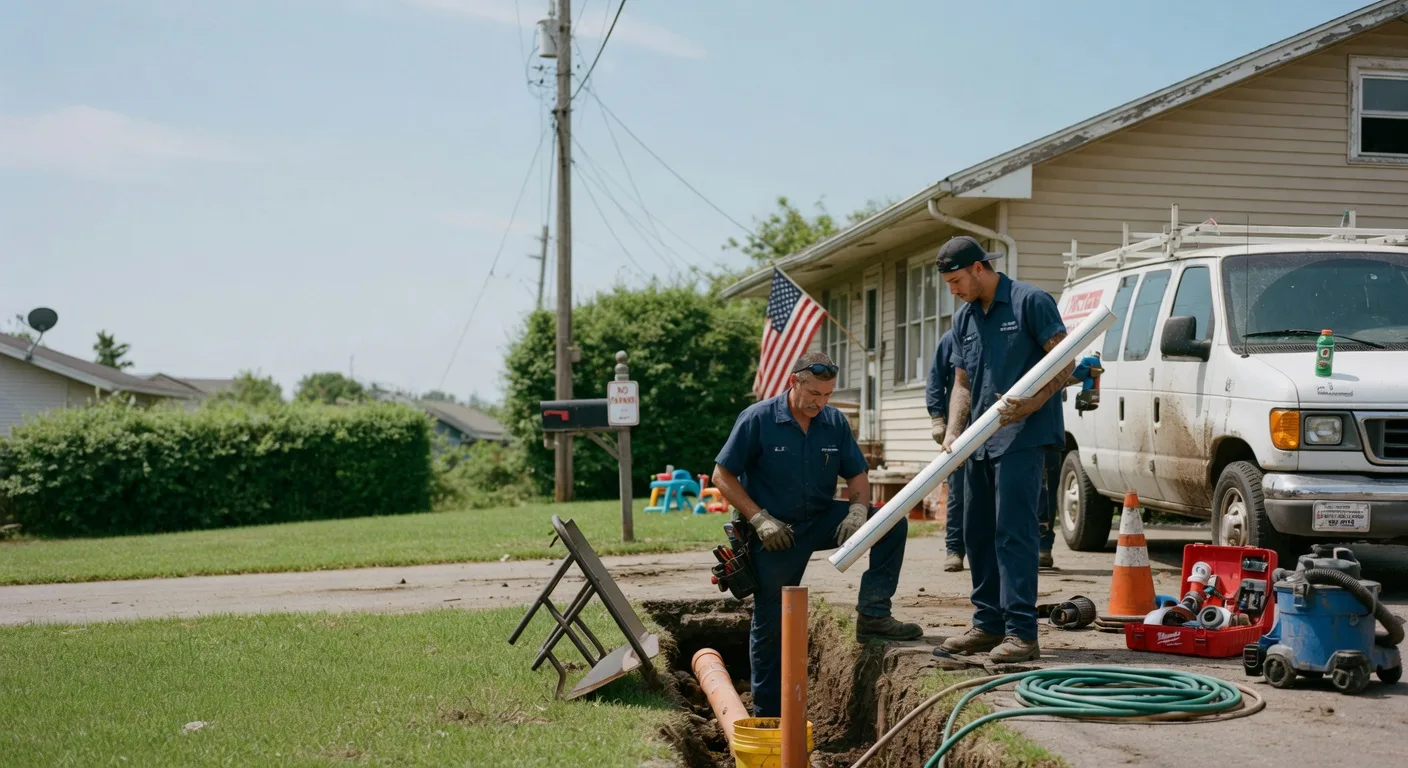
The city is replacing the street main outside our house. Why are our drains acting up now?
The crew has been digging up the street for a week, and now your toilets gurgle, the tub drains slowly, or you saw muddy water in a floor drain. It is natural to suspect the work outside. There are a few real reasons why it can be connected.
Your house drain, called the lateral, runs from your foundation to a connection on the city main. When the main is dug up and replaced, that connection is cut and reattached. Vibration, trench work and heavy equipment can crack an older clay or cast iron lateral, push a joint out of line, or shift the pipe so water now pools in a low spot. Dirt, gravel and construction debris can also wash into the line while connections are open. The work can also cause temporary backups while flow is being rerouted or the new pipe is flushed.
The key question is whether it is one fixture or the whole house. A single slow sink is probably the fixture. If every drain is sluggish, gurgling or backing up at once, particularly the lowest ones, the trouble is in the lateral or the main, and the street work is a likely suspect.
Safe homeowner check: write down when the symptoms began and compare that to when work started near your address. Take photos of any muddy water, debris or wet floor. Check whether neighbors have the same trouble. Run one tap for a minute and see if the lowest drain in the house reacts.
Stop running water and call now if sewage is coming up in a tub or floor drain, if there is standing water in the basement, or if you smell sewage inside the house. Do not keep using the washer or dishwasher.
Tell the utility or the contractor promptly. They may have a claims process, and a delay can make it harder to show when the damage started. A cable machine may be enough if loose debris is the problem. If the lateral is cracked, offset or holding water, the plumber will need a camera inspection to see the damage, and hydro jetting can flush out silt and gravel.
Expert Plumbers Co is a referral service. We connect you with an independent local plumber in Baisden, WV. Call (380) 262-9173.
Ask the plumber to record the camera inspection and write down the footage location of any damage, so you can give it to the city or contractor. Scope depends on how deep the pipe is, how much has to be dug up or opened, parts and materials, and any permit or code requirement. Responsibility for the repair varies by area, so confirm who owns which section of the line.